

GNPC Opens Dialogue on Mandate, Performance, and Road to Operatorship
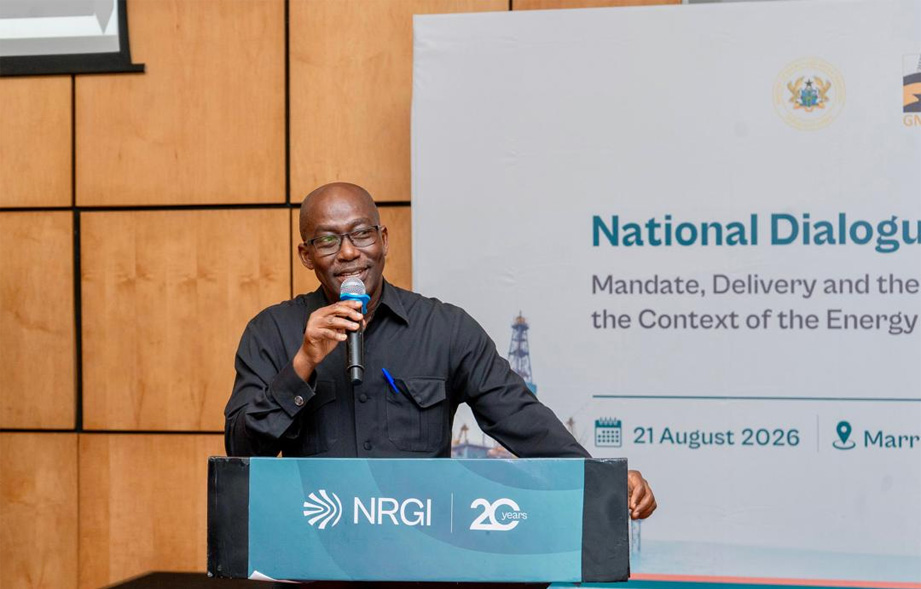
The Ghana National Petroleum Corporation (GNPC), partnering with the Natural Resource Governance Institute (NRGI), held a stakeholder engagement that brought together government, civil society, and industry stakeholders for an open discussion on the Corporation’s mandate, performance, and road to operatorship in a changing energy landscape.
Held under the theme "GNPC Today: Understanding the Mandate, Delivering the Road to Operatorship in the Context of the Energy Transition,” the engagement provided a platform for participants to examine GNPC’s evolving role as Ghana’s National Oil Company and discuss the institutional, commercial, and policy considerations that will shape its future.
Opening the engagement, GNPC Chief Executive Mr. Kwame Ntow Amoah welcomed the opportunity for constructive scrutiny of the Corporation, noting that conversations about GNPC’s future must begin with a proper understanding of its mandate and the distinct responsibilities it carries as a National Oil Company.
He explained that GNPC’s role extends beyond the commercial considerations that typically drive private international oil companies. As Ghana’s National Oil Company and an anchor investor in the petroleum sector, the Corporation must balance commercial performance with long-term national interests, sustainability, energy security, and the responsible development of Ghana’s petroleum resources.
Mr. Amoah also reflected on GNPC’s history in Ghana’s upstream petroleum industry, stressing that the Corporation undertook significant exploration and technical work long before the country’s commercial oil discovery.
He noted that GNPC’s participation in petroleum agreements should therefore not be interpreted as spectatorship, adding that partnerships remain an important part of managing the considerable technical and financial risks associated with petroleum exploration and production.
“When others leave, GNPC will still be here,” he said, underscoring the Corporation’s long-term responsibility to Ghana and the need to build an institution capable of sustaining that mandate.
Providing Government’s perspective, Director of Petroleum at the Ministry of Energy and Green Transition, Mr. Mark Prempeh, highlighted the importance of positioning GNPC to assume a stronger commercial role in Ghana’s petroleum industry.
He pointed to GNPC’s gas commercialisation activities and the increasing use of domestic natural gas in place of liquid fuels for thermal power generation as an important contribution to Ghana’s energy security and power sector.
Mr. Prempeh also indicated that work was underway to review aspects of GNPC’s enabling legislation, PNDC Law 64, to ensure the Corporation’s governing framework remains responsive to developments within the petroleum and wider energy sector.
He further highlighted ongoing work on Ghana’s fiscal and regulatory framework to improve the competitiveness of the upstream petroleum sector and attract investment, while expressing Government’s support for GNPC’s operatorship ambitions and greater commercial participation.
The engagement also heard perspectives from civil society on GNPC’s performance, governance, financial sustainability and the broader conditions required to build a commercially resilient National Oil Company.
Policy Lead at the Africa Centre for Energy Policy (ACEP), Kodzo Yaotse, presented an assessment of the Corporation and raised issues for consideration around GNPC’s financial position, governance, investment choices, and long-term sustainability.
The differing perspectives set the stage for a panel discussion featuring GNPC Deputy Chief Executive for Exploration and Production, Mr. Michael Aryeetey; Benjamin Boakye of ACEP; Dr. Steve Manteaw of the Ghana Extractive Industries Transparency Initiative (GHEITI); and Dr. Theo Acheampong of the Ministry of Finance.
The panel examined GNPC’s transformation strategy, operatorship ambitions, and the respective roles of government, the Corporation, and civil society in strengthening Ghana’s petroleum sector.
Mr. Aryeetey called for sustained constructive engagement between GNPC and civil society, recognising the important role of CSOs in interrogating developments within the sector, contributing alternative perspectives, and helping shape conversations about its future.
The discussions throughout the engagement reflected both areas of convergence and differing views on the direction of the Corporation, reinforcing the importance of continued dialogue as GNPC works to strengthen its commercial position and institutional capacity.
For GNPC, the engagement is part of a broader commitment to maintain open engagement with stakeholders, improve understanding of its mandate, and listen to perspectives that can contribute to a stronger and more sustainable National Oil Company.
The Corporation will continue to engage government, civil society, industry, and other stakeholders as it works to deliver greater value from Ghana’s petroleum resources and strengthen its contribution to the country’s long-term energy future.